Security and Privacy of User Data in Healthcare

December 22, 2025
9 min
read

Ensuring Security and Privacy of User Data in Healthcare App Development: Best Practices and Real-World Examples

Core Insights

Protecting user data in healthcare app development is essential for legal compliance and patient trust. To ensure security and privacy, developers must use robust encryption, enforce strong authentication, comply with regulations like HIPAA and GDPR, and offer users clear control over their data. These measures help prevent data breaches, ensure confidentiality, and support ethical healthcare delivery. This article outlines the most effective ways to secure healthcare applications, covering technical, regulatory, and user-facing strategies, backed by real-world case studies from Apzumi’s work with certified medical devices, remote care platforms, and multi-party healthcare ecosystems.

Why Security and Privacy Matter in Healthcare Apps

In today’s digital healthcare landscape, mobile and web applications process vast amounts of sensitive patient data, ranging from lab results and prescriptions to electronic health records and biometric signals. This information, classified as Protected Health Information (PHI), requires the highest levels of protection under strict legal frameworks like the Health Insurance Portability and Accountability Act (HIPAA) in the U.S. and the General Data Protection Regulation (GDPR) in the EU.

Security breaches not only result in legal consequences and reputational damage. They directly compromise patient safety. Improperly accessed or altered data can lead to misdiagnoses or unauthorized disclosure of medical information. According to IBM, healthcare suffers the highest cost per data breach across industries, averaging over $10 million per incident.

For healthcare app developers, ensuring data privacy is a core responsibility, central to ethical, secure, and trustworthy digital care delivery.

7 Proven Strategies for Securing Healthcare App Data

The following strategies represent the foundation of secure healthcare app development. Each is backed by real-world implementation in Apzumi’s healthcare projects.

1. Data Encryption in Transit and at Rest

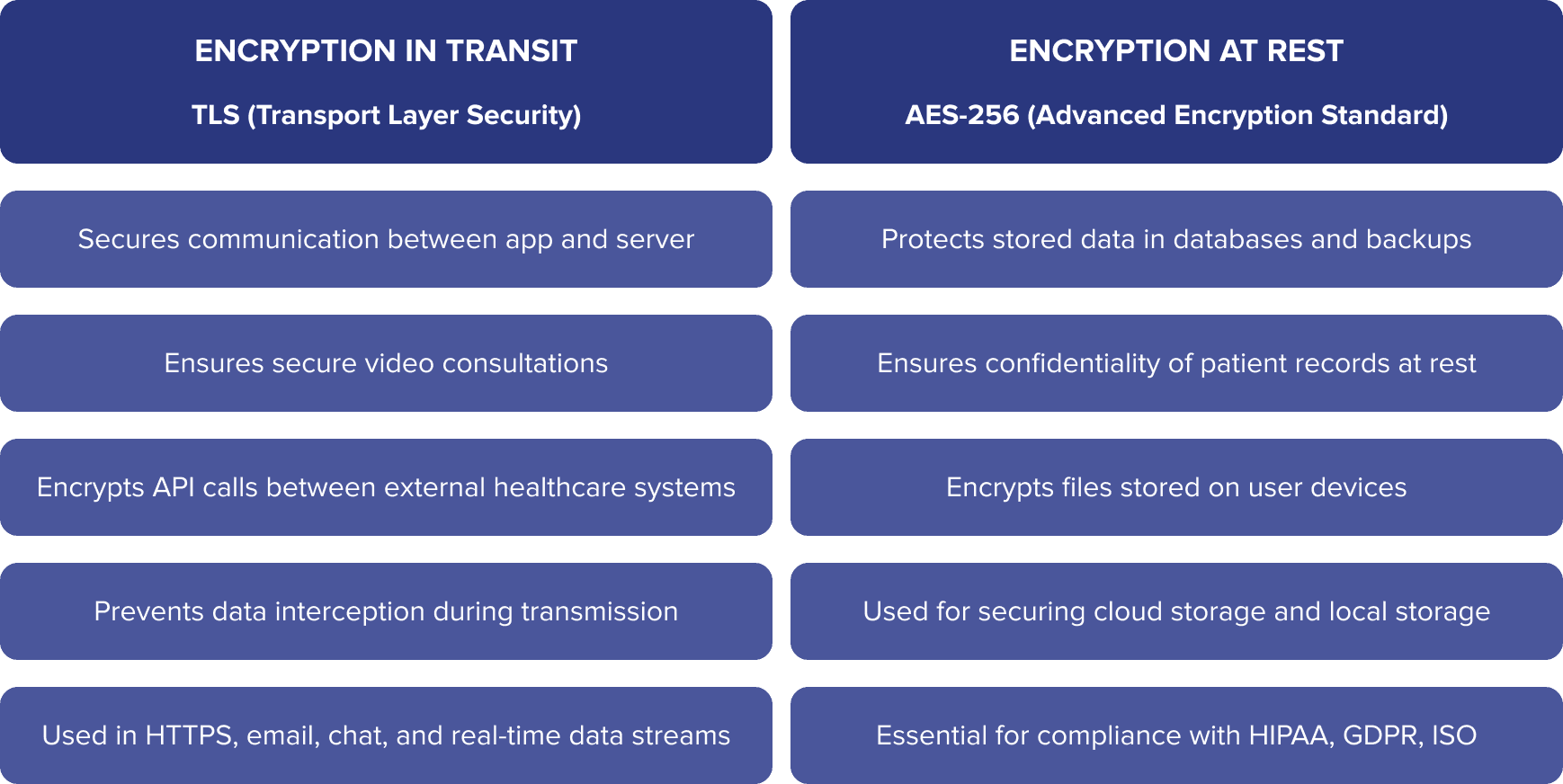
Healthcare data encryption is one of the most critical safeguards in protecting sensitive information like lab results, prescriptions, or diagnostic images. To secure data in transit during video consultations, test result uploads, or API exchanges, apps must implement TLS (Transport Layer Security) to ensure secure data transmission. Equally important is encrypting PHI (Protected Health Information) at rest using robust standards like AES-256, which protects data stored on devices or cloud servers.
Case Study: Apzumi applied end-to-end encryption in solutions like Calpro, where PHI is analyzed and transferred securely, and Telehealth, which ensures encrypted communication between patients and doctors.

2. Strong User Authentication and Role-Based Access

To prevent unauthorized access to sensitive medical records, user authentication must go beyond simple passwords. Multi-factor authentication in healthcare apps, such as biometric login or time-sensitive codes, adds a critical layer of protection. It ensures only verified users can access or modify sensitive data.

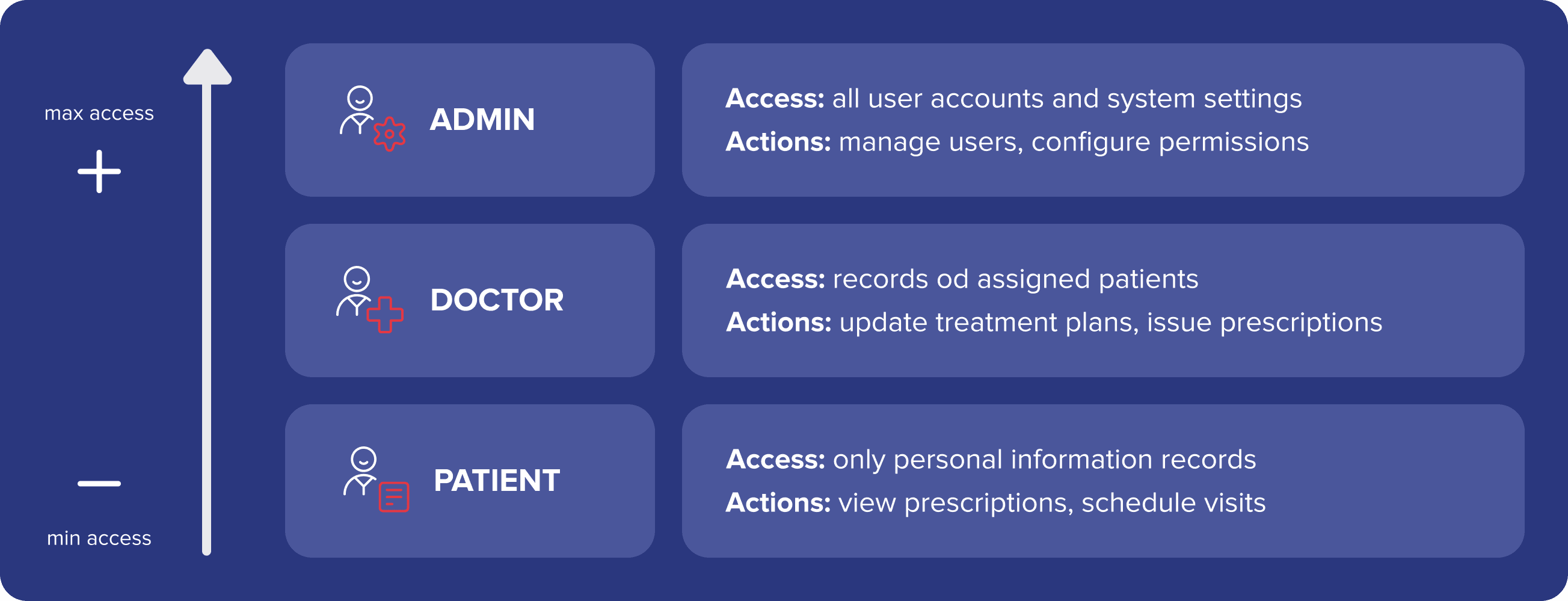
In addition, Role-Based Access Control (RBAC) in medical software helps restrict access based on a user’s role. For example, patients can only access their records, while doctors or administrators can view a broader dataset.

Case Study: We implemented both MFA and RBAC in Telehealth, providing secure, tiered access across its patient, doctor, and admin interfaces.
3. Secure Data Storage & Hosting Infrastructure

Ensuring secure data storage in healthcare apps means choosing a technically robust and HIPAA-compliant infrastructure. Sensitive data should be stored on servers or cloud platforms that support encryption at rest, routine backups, and access controls. Regular software updates and infrastructure patching are also critical to prevent exploits.

Using cloud infrastructure for healthcare, like AWS with compliance configurations, enables both scalability and security.

Case Study: For Chanl Health, Apzumi deployed a HIPAA-compliant hosting setup that manages real-time patient data, such as heart rate and blood pressure, while maintaining privacy and performance across 50+ U.S. hospitals.

4. Compliance with HIPAA, GDPR, and Global Standards

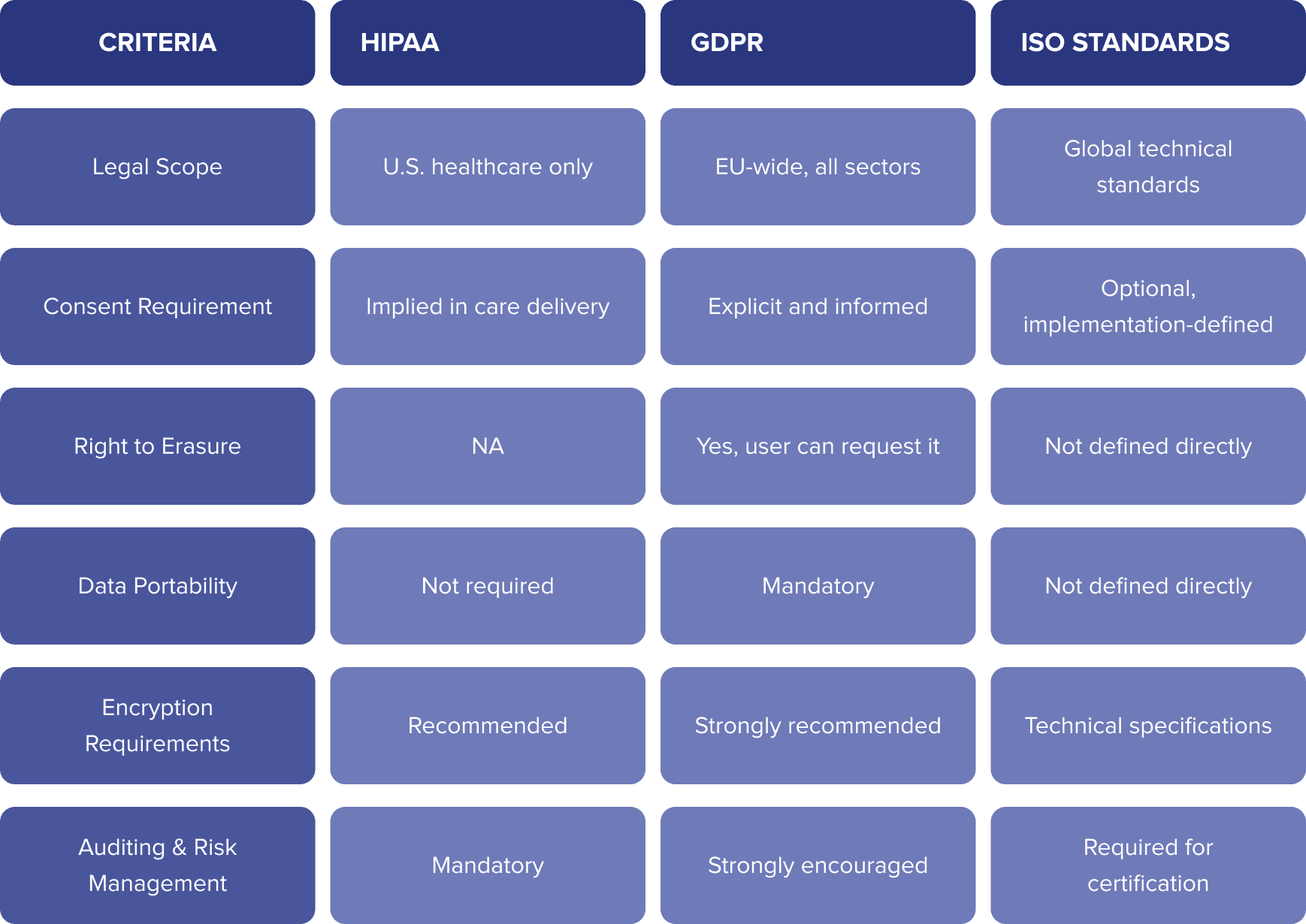
Healthcare apps must comply with regional and international regulations that govern the use and protection of personal health data. In the U.S., HIPAA-compliant app development requires safeguards for storing, transmitting, and accessing PHI (Protected Health Information). In the EU, GDPR in healthcare apps mandates user consent, data portability, and the right to erasure.

But compliance is more than just a legal necessity. It builds user trust and protects businesses from costly penalties.
Case Study: Apzumi supports regulatory adherence across projects like Chanl Health and Calpro, which meet HIPAA, ISO 13485, and IEC 62304 standards for secure, compliant digital health solutions.

5. Transparent Consent Management and Privacy Controls

Healthcare apps must prioritize user consent by clearly communicating how personal data is collected, used, and shared. Modern platforms should offer privacy settings for patients, including options to manage what data is visible, revoke permissions, or delete accounts entirely, supporting GDPR principles like the right to erasure.

Beyond legal compliance, transparent privacy controls increase user confidence and engagement.

Case Study: In the UzObi Medical BLUEPRINT™, Apzumi designed a system that empowers users to share their data with trusted contacts while retaining full control over what’s visible and editable. 

6. Ongoing Security Audits and Penetration Testing

Security in healthcare app development is an ongoing responsibility. Regular healthcare app security audits help identify outdated dependencies, misconfigurations, and access vulnerabilities before they become threats. Developers should also perform penetration testing for medical apps to simulate real-world attacks and expose weak points.

A structured risk assessment in healthcare apps ensures that new features or integrations don’t introduce unseen vulnerabilities.

Case Study: Apzumi provides long-term support for platforms like Chanl Health, continuously monitoring performance, adapting to regulatory changes, and implementing proactive security improvements.

7. Educating Teams on Security Protocols

Even the most secure code can be compromised if the development or support team lacks proper training. Providing HIPAA training for developers ensures everyone understands how to handle sensitive patient data. Ongoing security awareness in healthcare IT also reduces the risk of human error, social engineering, or insider misuse.

Strict internal access control in apps, including activity logging and role restrictions, adds another layer of defense against data leaks.

Case Study: Across complex platforms like Meedy, Apzumi helps client teams implement secure workflows and access controls to protect patient data across insurers, clinics, and users.

What Secure-by-Design Means in Practice

In secure healthcare app development, security is a whole design philosophy. It’s important to approach each healthcare project with the belief that privacy, compliance, and trust must be built in from day one. 

This means designing authentication workflows that minimize risk while maximizing usability. It means using encryption by default, carefully defining access roles, and making regulatory requirements like HIPAA or GDPR core to the system architecture. It also means helping users understand how their data is handled, giving them meaningful control and transparency through well-designed interfaces.

Privacy-first software does it all: protects data and patient dignity, supports ethical care, and improves outcomes by enabling secure, seamless interactions.

True digital health innovation doesn’t come at the cost of compliance. It’s powered by it. That’s why top developers build regulatory-compliant health platforms that scale confidently across jurisdictions, stakeholders, and patient needs, without compromising security or performance.

Build Digital Health Solutions Patients Can Trust

Security and privacy are the foundation of user trust and the future of digital health. Whether you're building a remote care platform, a certified medical device, or a patient-facing wellness app, privacy-first healthcare app development protects not only data, but relationships.

We help healthcare organizations build HIPAA-compliant software that’s secure by design, user-friendly by necessity, and future-ready by default. Our development process embeds security at every layer – from infrastructure and code to patient-facing features.

Want to build a platform patients and providers can trust? Let’s talk about your vision and how we can protect it.

Security and Privacy of User Data in Healthcare

#technology

AES-256 encryption and MFA are the pillars of medical software. Our guide covers the technical essentials of building a secure-by-design healthcare platform.
July 7, 2025

Ensuring Security and Privacy of User Data in Healthcare App Development: Best Practices and Real-World Examples

Core Insights

Protecting user data in healthcare app development is essential for legal compliance and patient trust. To ensure security and privacy, developers must use robust encryption, enforce strong authentication, comply with regulations like HIPAA and GDPR, and offer users clear control over their data. These measures help prevent data breaches, ensure confidentiality, and support ethical healthcare delivery. This article outlines the most effective ways to secure healthcare applications, covering technical, regulatory, and user-facing strategies, backed by real-world case studies from Apzumi’s work with certified medical devices, remote care platforms, and multi-party healthcare ecosystems.

Why Security and Privacy Matter in Healthcare Apps

In today’s digital healthcare landscape, mobile and web applications process vast amounts of sensitive patient data, ranging from lab results and prescriptions to electronic health records and biometric signals. This information, classified as Protected Health Information (PHI), requires the highest levels of protection under strict legal frameworks like the Health Insurance Portability and Accountability Act (HIPAA) in the U.S. and the General Data Protection Regulation (GDPR) in the EU.

Security breaches not only result in legal consequences and reputational damage. They directly compromise patient safety. Improperly accessed or altered data can lead to misdiagnoses or unauthorized disclosure of medical information. According to IBM, healthcare suffers the highest cost per data breach across industries, averaging over $10 million per incident.

For healthcare app developers, ensuring data privacy is a core responsibility, central to ethical, secure, and trustworthy digital care delivery.

7 Proven Strategies for Securing Healthcare App Data

The following strategies represent the foundation of secure healthcare app development. Each is backed by real-world implementation in Apzumi’s healthcare projects.

1. Data Encryption in Transit and at Rest

Healthcare data encryption is one of the most critical safeguards in protecting sensitive information like lab results, prescriptions, or diagnostic images. To secure data in transit during video consultations, test result uploads, or API exchanges, apps must implement TLS (Transport Layer Security) to ensure secure data transmission. Equally important is encrypting PHI (Protected Health Information) at rest using robust standards like AES-256, which protects data stored on devices or cloud servers.

Case Study: Apzumi applied end-to-end encryption in solutions like Calpro, where PHI is analyzed and transferred securely, and Telehealth, which ensures encrypted communication between patients and doctors.

2. Strong User Authentication and Role-Based Access

To prevent unauthorized access to sensitive medical records, user authentication must go beyond simple passwords. Multi-factor authentication in healthcare apps, such as biometric login or time-sensitive codes, adds a critical layer of protection. It ensures only verified users can access or modify sensitive data.

In addition, Role-Based Access Control (RBAC) in medical software helps restrict access based on a user’s role. For example, patients can only access their records, while doctors or administrators can view a broader dataset.

Case Study: We implemented both MFA and RBAC in Telehealth, providing secure, tiered access across its patient, doctor, and admin interfaces.

3. Secure Data Storage & Hosting Infrastructure

Ensuring secure data storage in healthcare apps means choosing a technically robust and HIPAA-compliant infrastructure. Sensitive data should be stored on servers or cloud platforms that support encryption at rest, routine backups, and access controls. Regular software updates and infrastructure patching are also critical to prevent exploits.

Using cloud infrastructure for healthcare, like AWS with compliance configurations, enables both scalability and security.

Case Study: For Chanl Health, Apzumi deployed a HIPAA-compliant hosting setup that manages real-time patient data, such as heart rate and blood pressure, while maintaining privacy and performance across 50+ U.S. hospitals.

4. Compliance with HIPAA, GDPR, and Global Standards

Healthcare apps must comply with regional and international regulations that govern the use and protection of personal health data. In the U.S., HIPAA-compliant app development requires safeguards for storing, transmitting, and accessing PHI (Protected Health Information). In the EU, GDPR in healthcare apps mandates user consent, data portability, and the right to erasure.

But compliance is more than just a legal necessity. It builds user trust and protects businesses from costly penalties.

Case Study: Apzumi supports regulatory adherence across projects like Chanl Health and Calpro, which meet HIPAA, ISO 13485, and IEC 62304 standards for secure, compliant digital health solutions.

5. Transparent Consent Management and Privacy Controls

Healthcare apps must prioritize user consent by clearly communicating how personal data is collected, used, and shared. Modern platforms should offer privacy settings for patients, including options to manage what data is visible, revoke permissions, or delete accounts entirely, supporting GDPR principles like the right to erasure.

Beyond legal compliance, transparent privacy controls increase user confidence and engagement.

Case Study: In the UzObi Medical BLUEPRINT™, Apzumi designed a system that empowers users to share their data with trusted contacts while retaining full control over what’s visible and editable. 

6. Ongoing Security Audits and Penetration Testing

Security in healthcare app development is an ongoing responsibility. Regular healthcare app security audits help identify outdated dependencies, misconfigurations, and access vulnerabilities before they become threats. Developers should also perform penetration testing for medical apps to simulate real-world attacks and expose weak points.

A structured risk assessment in healthcare apps ensures that new features or integrations don’t introduce unseen vulnerabilities.

Case Study: Apzumi provides long-term support for platforms like Chanl Health, continuously monitoring performance, adapting to regulatory changes, and implementing proactive security improvements.

7. Educating Teams on Security Protocols

Even the most secure code can be compromised if the development or support team lacks proper training. Providing HIPAA training for developers ensures everyone understands how to handle sensitive patient data. Ongoing security awareness in healthcare IT also reduces the risk of human error, social engineering, or insider misuse.

Strict internal access control in apps, including activity logging and role restrictions, adds another layer of defense against data leaks.

Case Study: Across complex platforms like Meedy, Apzumi helps client teams implement secure workflows and access controls to protect patient data across insurers, clinics, and users.

What Secure-by-Design Means in Practice

In secure healthcare app development, security is a whole design philosophy. It’s important to approach each healthcare project with the belief that privacy, compliance, and trust must be built in from day one. 

This means designing authentication workflows that minimize risk while maximizing usability. It means using encryption by default, carefully defining access roles, and making regulatory requirements like HIPAA or GDPR core to the system architecture. It also means helping users understand how their data is handled, giving them meaningful control and transparency through well-designed interfaces.

Privacy-first software does it all: protects data and patient dignity, supports ethical care, and improves outcomes by enabling secure, seamless interactions.

True digital health innovation doesn’t come at the cost of compliance. It’s powered by it. That’s why top developers build regulatory-compliant health platforms that scale confidently across jurisdictions, stakeholders, and patient needs, without compromising security or performance.

Build Digital Health Solutions Patients Can Trust

Security and privacy are the foundation of user trust and the future of digital health. Whether you're building a remote care platform, a certified medical device, or a patient-facing wellness app, privacy-first healthcare app development protects not only data, but relationships.

We help healthcare organizations build HIPAA-compliant software that’s secure by design, user-friendly by necessity, and future-ready by default. Our development process embeds security at every layer – from infrastructure and code to patient-facing features.

Want to build a platform patients and providers can trust? Let’s talk about your vision and how we can protect it.

LinkedIn
Facebook
X (Twitter)
YouTube