technology
Choosing Technologies & Frameworks for Healthcare

Paweł Kozera
Choosing the Right Technologies and Frameworks for Healthcare App Development
Core Insights / Key Takeaways
Developing a healthcare app requires choosing the right technologies and frameworks to ensure security, scalability, and compliance with healthcare regulations such as HIPAA. The best tech stack for healthcare apps includes native or cross-platform mobile frameworks, modern web development tools, secure cloud platforms, robust databases, and AI integration. In this article, we’ll explore the most suitable options and explain how to make the right decision for your project.
Building Healthcare Apps Starts with the Right Technology
When developing a healthcare app, the first and most important decision is the technology stack. The frameworks and tools you select will determine whether the app can securely process patient data, scale to thousands of users, and remain compliant with regulations like HIPAA. In other words, before designing features or user interfaces, you need to decide: what’s under the hood?
A scalable healthcare app depends on the right foundations:
- Security by design – protecting sensitive health records with encryption and secure protocols.
- Performance across platforms – from native iOS and Android apps to cross-platform frameworks like React Native or Flutter.
- Future-proof architecture – cloud services such as AWS HIPAA-compliant backends that allow for easy growth.
- Interoperability – smooth integration with EHR systems and external APIs.
The right technology choices are what make the difference between an app that simply works and one that healthcare providers and patients can trust.
Why the Tech Stack Defines Healthcare App Success
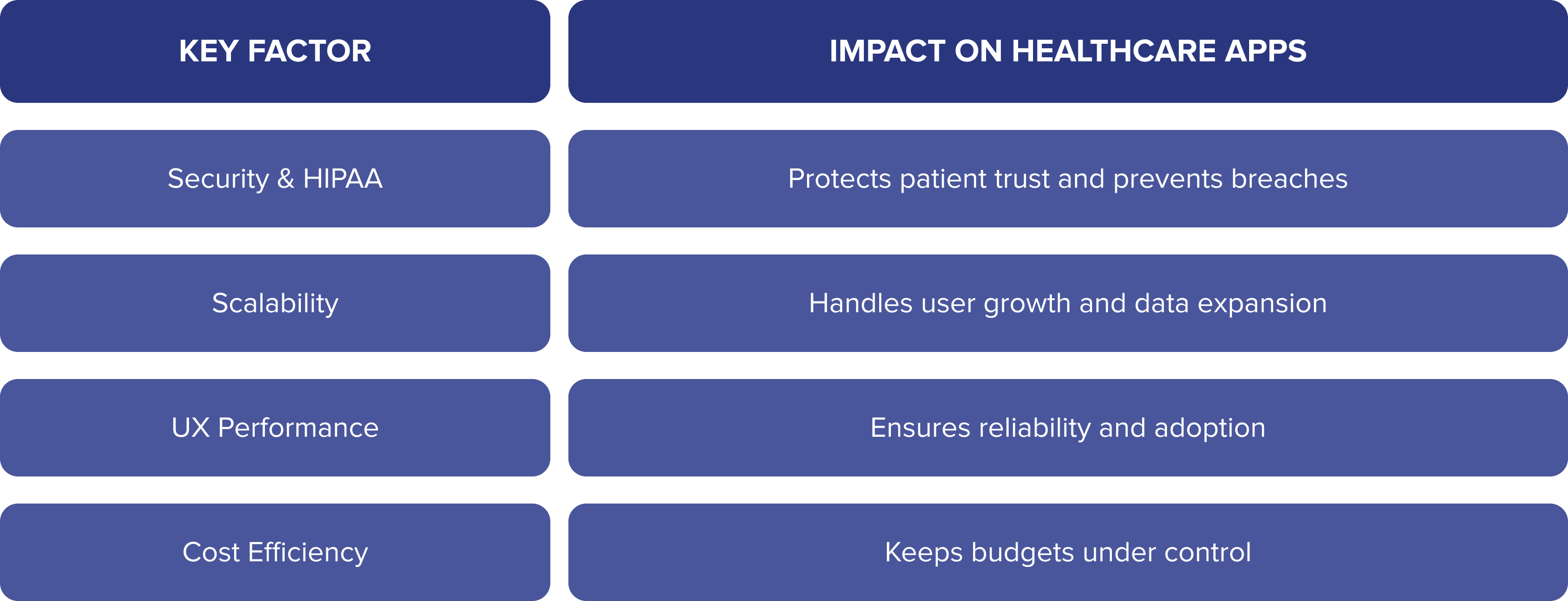
In healthcare, an app is only as strong as the technologies behind it. The choice of frameworks and infrastructure directly affects how well the app performs, how securely it handles sensitive patient data, and whether it can adapt to future demands. A poor decision at this stage can lead to costly rewrites, compliance risks, or limited scalability.
Here’s why selecting the right healthcare app development technologies is critical:
- Compliance and Security: Only a secure healthcare application development stack can ensure HIPAA-compliant healthcare mobile app development with encryption and safe data handling.
- Scalability: A scalable healthcare app must cope with growing user bases, larger data volumes, and complex integrations without performance loss.
- User Experience: Technologies influence responsiveness, stability, and accessibility, all of which define trust in a healthcare context.
- Cost and Efficiency: The right frameworks minimize long-term maintenance costs and accelerate development.
Mobile App Development Frameworks
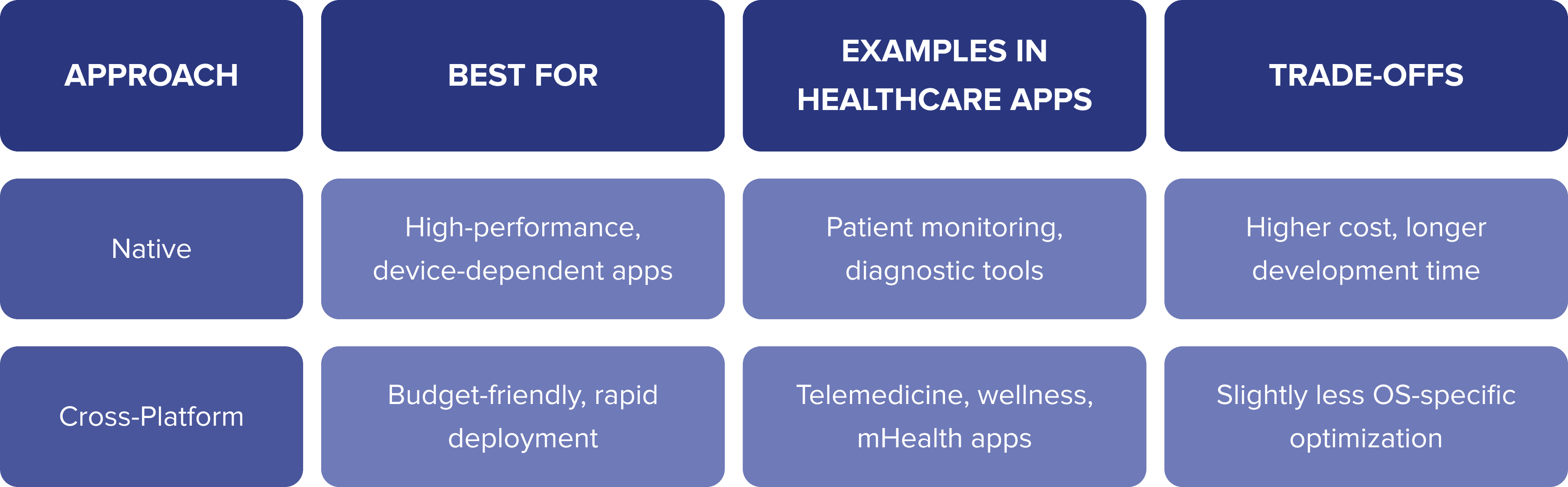
One of the first choices in healthcare mobile app development is whether to build natively or with a cross-platform framework. Both approaches can deliver secure, high-quality apps. The difference lies in performance needs, budget, and time-to-market.
Native Development
Building separately for iOS (Swift/Objective-C) and Android (Java/Kotlin) gives you maximum performance and deep integration with device features like biometrics or health sensors. This makes it ideal for apps handling real-time monitoring or requiring advanced device access.
Cross-Platform Development
Frameworks like React Native and Flutter allow one codebase to run on both platforms. This reduces costs and accelerates development, making it a strong choice for telemedicine platforms or mHealth apps where speed of delivery matters more than hardware-level customization.
In short:
- Go native if precision, performance, and security integrations are non-negotiable.
- Go cross-platform if you need to launch quickly across devices without doubling costs.
Web Development Technologies
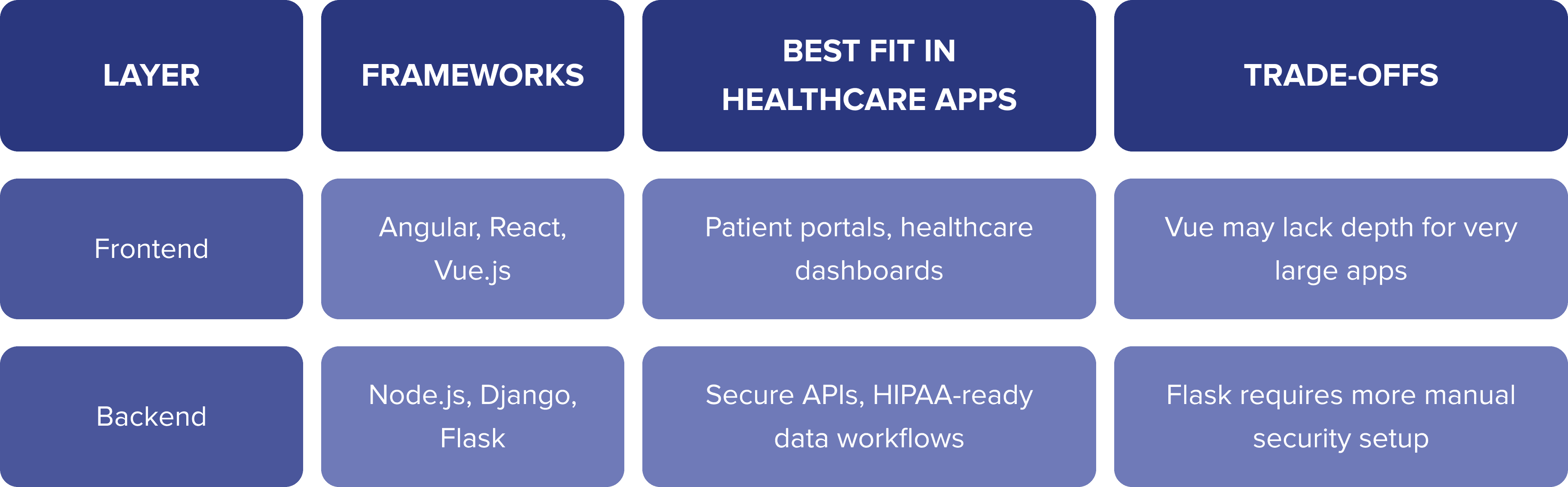
For healthcare providers, web apps are just as important as mobile ones — powering patient portals, admin dashboards, and EHR integrations. The decision here revolves around selecting the right frontend and backend frameworks to ensure usability, security, and scalability.
Frontend Frameworks
- Angular – strong structure, suited for large-scale healthcare platforms.
- React – flexible, widely adopted, great for responsive interfaces.
- Vue.js – lightweight, easier learning curve, good for rapid rollouts.
Backend Frameworks
- Node.js – event-driven, ideal for real-time communication in healthcare (e.g., telemedicine).
- Django (Python) – excellent for secure healthcare application development, with built-in protections for authentication and data handling.
- Flask (Python) – lightweight and customizable, useful for smaller or experimental healthcare projects.
In short:
- Combine React (frontend) with Django (backend) for robust, HIPAA-ready healthcare platforms.
- Use Node.js when real-time communication (chat, video calls) is key.
- Pick Vue.js or Flask if speed and lightweight builds matter more than complex infrastructure.
Cloud Computing
Behind every successful healthcare app is a cloud platform that ensures scalability, security, and compliance. Choosing the right provider determines how well your app handles growth, protects sensitive data, and integrates with external systems.
Leading Cloud Providers
- AWS (Amazon Web Services) – a wide range of HIPAA-compliant services, from serverless computing to secure databases.
- Microsoft Azure – strong enterprise integrations, particularly useful for hospitals and larger healthcare networks.
- Google Cloud Platform (GCP) – advanced AI and analytics features for data-driven healthcare solutions.
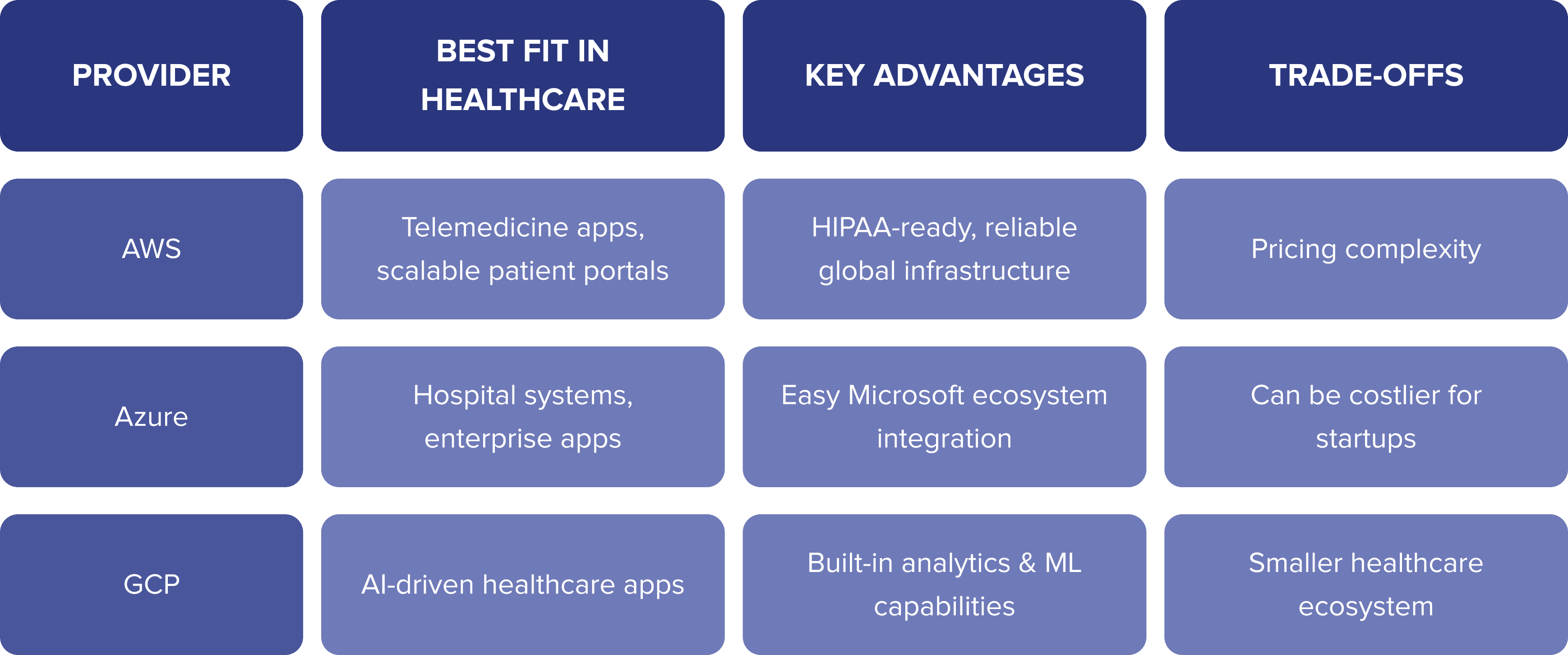
Recommendation:
- Choose AWS healthcare app backend if scalability is your top priority.
- Select Azure if you’re already invested in Microsoft healthcare IT solutions.
- Pick GCP if advanced AI/ML in healthcare is a core feature.
APIs and Data Exchange
A healthcare app rarely works in isolation, as it needs to connect with EHR systems, wearables, and third-party services. That’s why choosing the right approach to APIs and data exchange is critical for interoperability and compliance.
API Approaches
- RESTful APIs – widely used, reliable, and easier to implement for most healthcare apps.
- GraphQL – flexible, efficient queries, ideal for apps that require selective data retrieval and smooth integration with modern platforms.
Why It Matters
- Enables healthcare data interoperability with hospitals and insurance systems.
- Ensures secure healthcare application development through standardized protocols.
- Improves app performance by avoiding redundant data transfers.
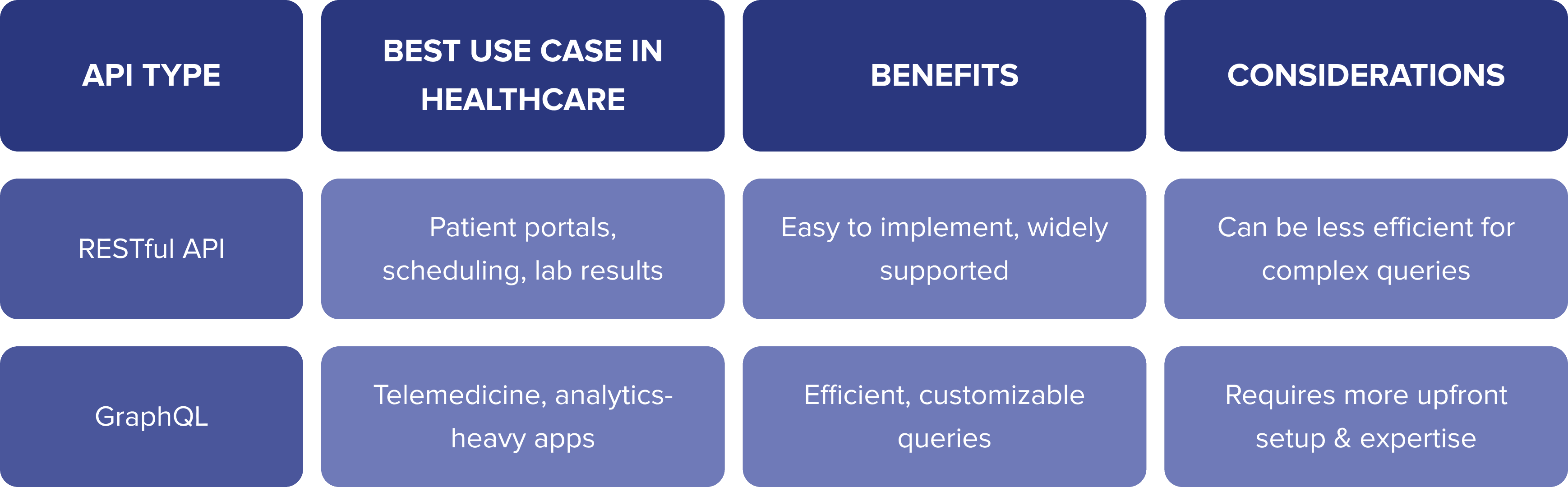
In short: Use RESTful APIs for most healthcare integrations, and consider GraphQL for healthcare apps where efficiency and flexibility matter most.
Database Management
Healthcare apps generate and process massive volumes of data, starting from patient records and lab results, ending at sensor readings from wearables. Choosing the right database management system is essential for performance, security, and compliance.
Relational Databases
- MySQL and PostgreSQL are reliable for structured healthcare data such as EHRs, billing, and appointment scheduling.
- Offer strong data integrity and ACID compliance, critical for healthcare systems where accuracy matters.
NoSQL Databases
- MongoDB and Firebase are better suited for unstructured or semi-structured data such as real-time monitoring or mobile app activity.
- Provide flexibility and scalability, ideal for mHealth apps that must adapt quickly.
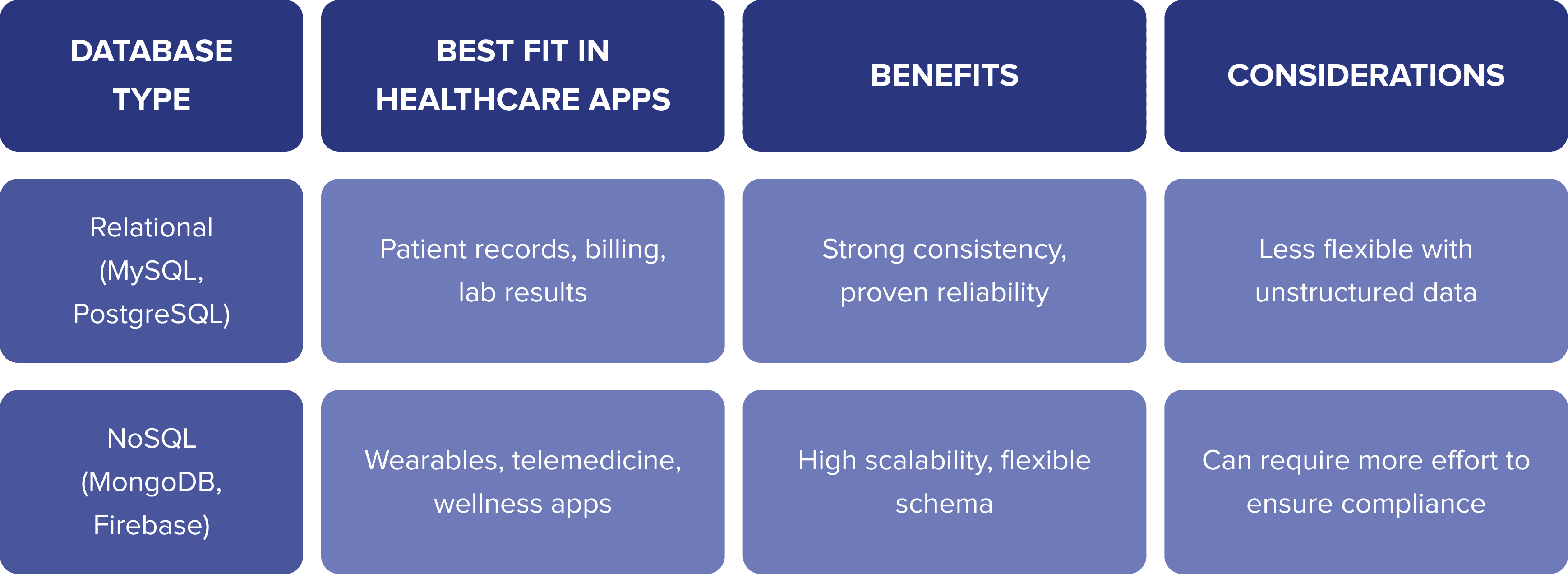
Recommendation:
- Use PostgreSQL healthcare apps where accuracy and compliance are critical.
- Choose MongoDB or Firebase if your app prioritizes scalability and handles diverse data types.
Security and Compliance in Healthcare App Development
When it comes to secure healthcare application development, there is no room for compromise. Healthcare apps handle sensitive patient data, which means every system must be designed to meet strict compliance standards like HIPAA in the U.S. and GDPR in Europe. A data breach undermines patient trust and can even put lives at risk.
Best Practices for Securing Healthcare Apps
- Encryption Everywhere
- Use AES encryption for stored data.
- Protect data in transit with HTTPS/TLS protocols.
- Use AES encryption for stored data.
- Authentication & Access Control
- Enforce multi-factor authentication (MFA).
- Apply role-based access to prevent unauthorized data access.
- Enforce multi-factor authentication (MFA).
- Compliance-Ready Infrastructure
- Deploy apps on HIPAA-compliant cloud services (AWS, Azure, GCP).
- Keep audit trails for all patient data interactions.
- Deploy apps on HIPAA-compliant cloud services (AWS, Azure, GCP).
- Secure Coding Standards
- Follow OWASP best practices for healthcare apps to prevent vulnerabilities like SQL injection or XSS.
- Run regular penetration testing.
- Follow OWASP best practices for healthcare apps to prevent vulnerabilities like SQL injection or XSS.
- Data Privacy by Design
- Store only necessary patient data.
- Anonymize and encrypt datasets used for analytics.
- Store only necessary patient data.
By combining encryption, compliance frameworks, and proactive monitoring, developers can build HIPAA-compliant healthcare mobile apps that patients and providers can trust.
AI and Machine Learning in Healthcare Apps
AI is transforming healthcare from reactive care to proactive, data-driven solutions. By integrating machine learning healthcare app capabilities, developers can add intelligence that goes beyond basic functionality, helping doctors, patients, and providers make better decisions.
Key Use Cases of AI in Healthcare Apps
- Predictive Analytics
- Hospitals use AI to forecast readmissions and resource needs.
- Example: A TensorFlow healthcare app can analyze patient history to identify who is at high risk of complications.
- Hospitals use AI to forecast readmissions and resource needs.
- Medical Imaging & Diagnosis Support
- ML models trained with PyTorch help radiologists detect anomalies in X-rays or MRIs.
- Supports faster and more accurate diagnoses.
- ML models trained with PyTorch help radiologists detect anomalies in X-rays or MRIs.
- Personalized Health Recommendations
- mHealth apps use ML to tailor exercise, nutrition, or medication reminders based on user behavior.
- Example: An AI-driven wellness app might suggest lifestyle changes to reduce heart risk.
- mHealth apps use ML to tailor exercise, nutrition, or medication reminders based on user behavior.
- Virtual Health Assistants & Chatbots
- Conversational AI supports telemedicine by answering FAQs, triaging symptoms, or guiding patients through follow-ups.
- Conversational AI supports telemedicine by answering FAQs, triaging symptoms, or guiding patients through follow-ups.
- Operational Efficiency
- AI helps optimize hospital scheduling, reduce patient wait times, and streamline billing processes.
- AI helps optimize hospital scheduling, reduce patient wait times, and streamline billing processes.
Implementation Frameworks
- TensorFlow – strong for predictive analytics and deep learning models.
- PyTorch – widely used in research and imaging-based healthcare solutions.
- scikit-learn – best for smaller-scale ML tasks, such as risk scoring or clustering patients by profile.
For healthcare innovators, the question is no longer whether to integrate AI, but where it will bring the most value. From predictive care to real-time patient support, AI-powered healthcare app development has the potential to improve outcomes and cut costs.
Key Takeaways and Final Recommendations
The success of any healthcare app depends on choosing technologies that balance innovation with compliance. A robust tech stack ensures that the app is not only functional but also secure, scalable, and ready to meet the strict demands of the healthcare industry. Decisions made around mobile frameworks, web technologies, cloud infrastructure, data exchange, and database management define how well the app performs in real-world use. Security and compliance are not optional layers but core foundations, while artificial intelligence opens new opportunities for predictive care and personalized health experiences.
For healthcare organizations, the right path forward is to align technology choices with long-term growth, regulatory requirements, and patient trust. At Apzumi, we help transform these decisions into working solutions, building HIPAA-compliant healthcare mobile apps and scalable web platforms that integrate cloud, security, and AI where they bring the most value. If your goal is to create a future-proof healthcare app, our team is ready to guide you through every stage of development.
Paweł Kozera
Marketing Specialist
Explore more



Let's stay in touch!