The Third-Week Drop-Off
Early retention and churn in health, wellbeing, and fitness apps - what the evidence says about when users leave, why they leave, and how to see it coming.
Download the full report
What's Inside
Most health, wellbeing, and fitness apps lose the vast majority of their new users within the first month, and the research points to a specific, predictable moment inside that collapse: a second wave of quitting between week two and week four, after the novelty of a new app wears off but before the habit has actually formed.
This brief pulls together the evidence behind that gap, benchmarked separately for medical, wellbeing, fitness, habit-building, and gamified apps, and breaks down why users in each category actually leave.
It also looks at how the best-documented consumer products in the world, Duolingo, Royal Match, and Apple Watch, engineered their way around the same problem, what tactics reliably backfire when apps push too hard to fight it, and the early-warning signals that flag a user about to lapse days before they do.
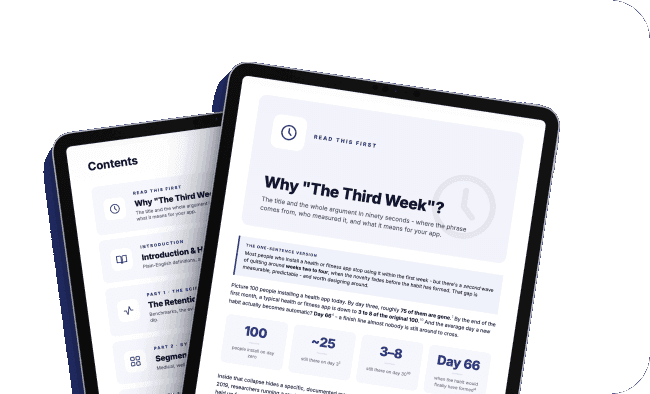
The Habit Takes 66 Days. Most Apps Lose Users by Day 21.
Why this matters
Acquiring a new user costs several times more than keeping one you already have, and for most health and wellness apps, the moment that decides whether that spend pays off arrives inside the first month, not months down the line.
Knowing that weeks two to four are a distinct danger zone, and knowing what specifically drives the drop in your category, turns retention from a vague ongoing worry into a concrete design and measurement problem with a known window to act in.
Health products carry an extra layer most growth playbooks ignore: the tactics that work well in gaming or social apps (streaks, leaderboards, aggressive notifications) can quietly cross into dark-pattern territory when the user is managing a condition or trying to feel calmer, not more competitive. Getting retention right here means designing for real outcomes, not just app opens, while still using the mechanics that are proven to work.
Founders and product leads at healthcare apps
Anyone deciding where to invest before scaling acquisition spend on a product that's still losing most users in the first month
Growth and onboarding teams
Teams who need to know exactly which early behaviors predict a week-three lapse, so they can act before the user is already gone
Teams building for employers, insurers, or clinical partners
Anyone whose retention numbers go to a buyer who isn't the end user, where engagement and outcomes can't be conflated

Tomasz Mirowski
UI/UX Designer