technology
Vibe-Coding in Healthcare: What You Can Build Alone, and Where You'll Need Help

Joanna Kasprzak
Core Insights
Vibe-coding genuinely works for building fast, alone or with a partner, and it lowers the bar for real collaboration along the way. What it can't do on its own is turn a fast, evolving build into something production-ready: the architecture, the standards, and the completeness checks that a full specialist team provides, not a single service. It also runs into limits healthcare specifically can't tolerate, non-deterministic behavior and design defaults built for an average patient rather than the real ones a product serves. Getting from a validated prototype to something that can actually go live usually needs someone to step in and turn a moving target into a finished foundation.
Introduction
Vibe-coding didn't just make building software faster. It changed who's in the room while it happens.
The old way of building software with a partner usually looked the same: a client describes what they want, someone writes it down, and a first version comes back for review weeks later. That delay was often the point: a specialist was gathering detailed requirements and manually sketching out every screen and every flow, customizing the UX and UI to the audience and the business goals before any of it became real. Vibe-coding collapses that gap. An idea can turn into a real, clickable prototype in the same hour it was described. The entry point for bringing in a technical partner has genuinely gotten lower, and that's changing the kind of work that happens in these early sessions, it's more creative, faster, and a lot more hands-on than a traditional discovery phase ever was.
What's less obvious is what that same real-time, ever-changing prototype is and isn't ready for once the session ends. A build that's still evolving is exactly what makes a discovery session feel alive. It's also exactly what makes it fragile ground to build a healthcare product on top of.
So here's the real question: once the idea's proven and the prototype exists, what can you still do yourself, and where does the work start needing someone else?
What You Can Do on Your Own
This part is worth taking seriously as a genuine shift, not just a footnote before the "but."
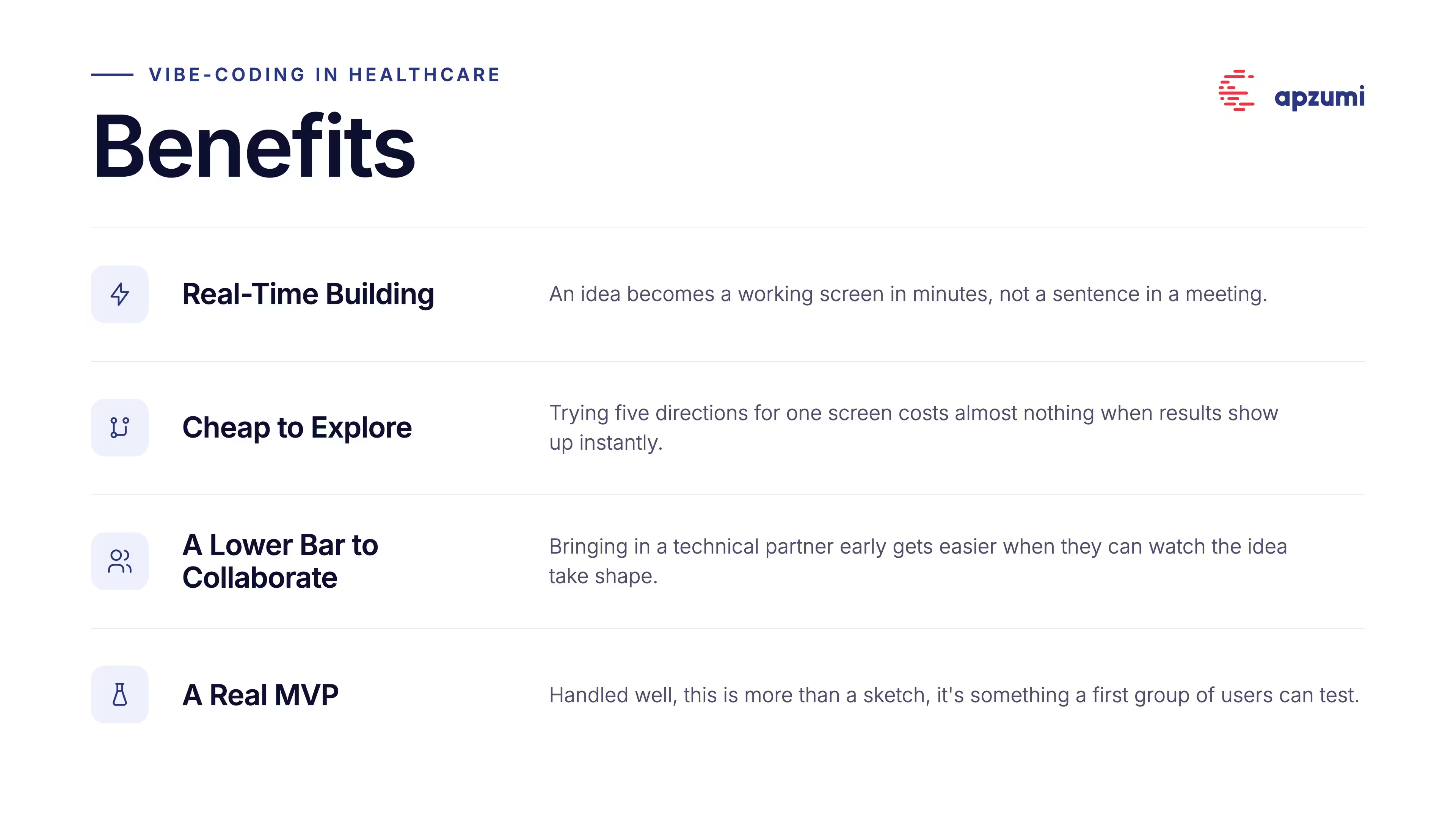
An idea can get built out loud, alone, using an AI tool as a canvas. A patient intake flow stops being a sentence in a plan and becomes an actual screen within minutes. That immediacy changes what's possible before anyone else is even involved, it's easier to get specific, and easier to try three versions of something in an hour, because trying costs almost nothing.
It's also faster in a way that goes beyond the coding itself. Vibecoders aren't writing code by hand at all, so trying five directions for a single screen or flow costs almost nothing when the result shows up immediately, which means exploring, throwing things out, and landing on the right version can happen solo, in the time it used to take just to describe it to someone else.
Handled well, what comes out of this can genuinely be more than a rough sketch. It can be a real proof of concept or an MVP, something a first group of users can actually test, built entirely independently.
Bringing in a technical partner at this stage is an upgrade, not a requirement. The same kind of session gets a specific perk on top: real business and functional documentation captured as the build happens, instead of written up later from scratch. That's not something a client typically has the setup to produce solo, and having it in place early is one of the things that makes the eventual move into real development faster.
Where the Limits Show Up
The same quality that makes a vibe-coding session so productive, the fact that it's alive and constantly changing, is exactly what stops it from being a finished product on its own. That shows up in a handful of specific, predictable ways.
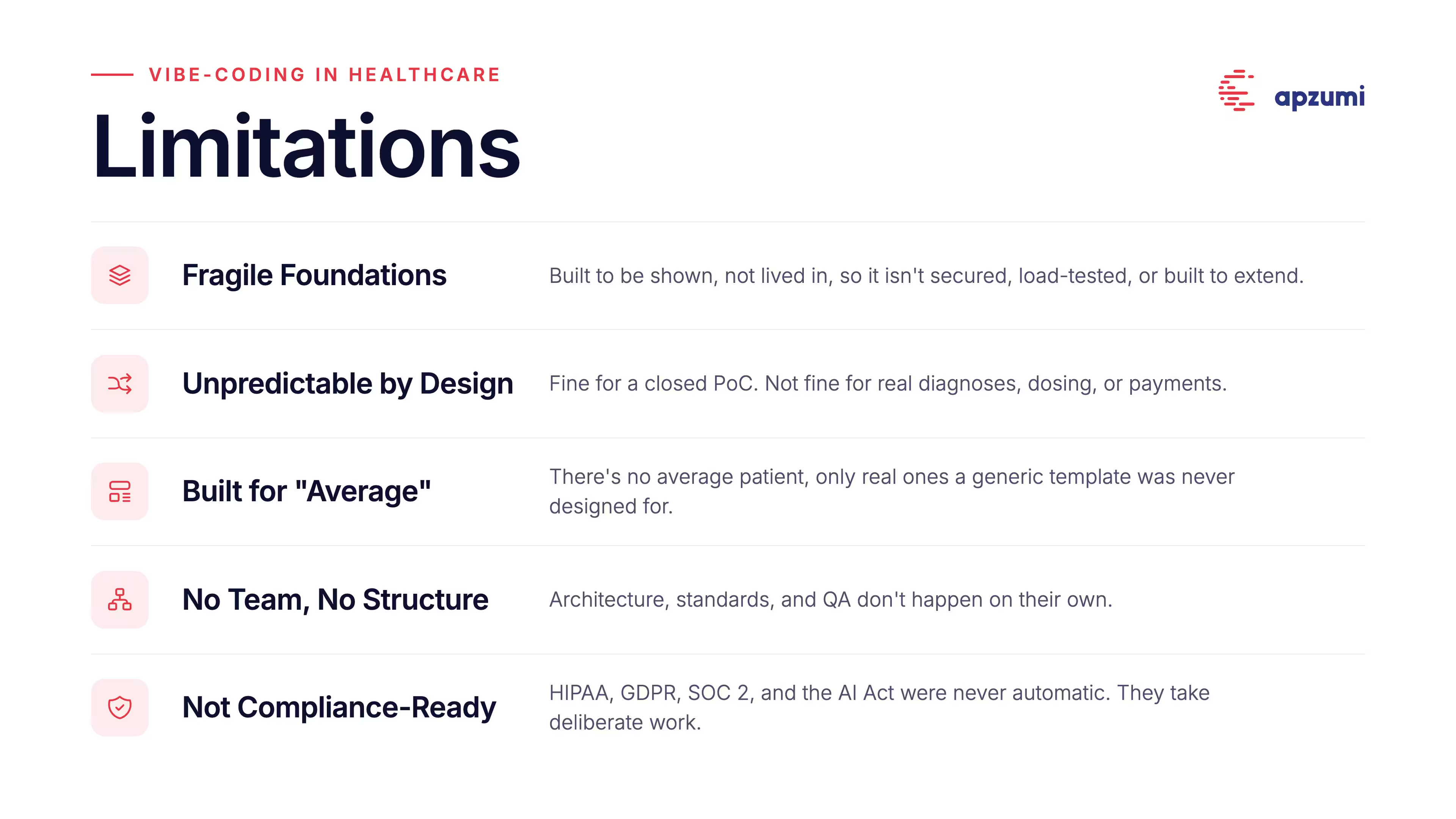
A prototype is built to be shown, not to be lived in. New versions keep arriving as the idea gets refined, which is exactly right for a discovery phase and exactly wrong for something that's supposed to hold still long enough to be secured, tested, and shipped. Someone eventually has to decide which version is the final one, and that decision doesn't happen inside the session itself.
Testing an idea and hardening a product are two different things. The first group of users who try a prototype are there to validate the idea, not to stress-test it. Access and data handling built for that kind of early testing rarely hold up against real attackers, and performance that looks fine for a handful of testers doesn't say much about how the system behaves at full patient volume, or how easily a structure built for speed can be extended and integrated once real construction starts.
It's non-deterministic exactly where healthcare can't tolerate that. AI-generated systems behave non-deterministically, and healthcare has entire categories of work that require the opposite: predictability, consistency, and repeatability, in recommendations, diagnoses, decisions, data, and integrations. That's fine for a small, closed proof of concept meant to validate an idea with a first group of users. It can become risky the moment real payments, real medical data exchange, real recommendations or diagnoses, or medication dosage calculations enter the picture. Imagine a patient getting a different recommendation for the same symptoms, or a different dosage for the same diagnosis, every time they ask the same algorithm for guidance.
It designs for an average patient, and there's no such thing. AI tools default to whatever interface conventions they were trained on most, the same handful of design patterns used across most consumer apps. That's a reasonable average for a shopping app. It's the wrong average for healthcare, where a single product might need to work for a newly diagnosed teenager who doesn't want the app to look clinical at all, and, in the same week, for an older patient managing a chronic condition who has rarely used a touchscreen for anything more involved than answering a call. A clinician glancing at the same screen between appointments has no patience for an extra tap. None of that shows up in a generic template. It shows up in specific decisions: sizing controls for someone with reduced grip strength, choosing contrast and text size that actually works for a patient whose eyesight has been affected by their condition, writing instructions in language that doesn't assume health literacy it can't count on. A generic build won't make those calls on its own. Someone who actually knows the patient has to.
It doesn't produce documentation, architecture, or completeness on its own. Going live is work for a full team, not a single checklist, it takes a business analyst to pin down what was actually meant, QA to test beyond the paths anyone thought to try, and backend, frontend, and UI/UX specialists to carry it the rest of the way. The real value that team brings is architectural: thinking through how the system holds together, controlling the concept as it gets built out, knowing and applying the standards the market actually requires, preparing the app for scaling it hasn't faced yet, and checking the implementation for completeness well beyond the happy path anyone demoed. AI-generated code holds up fine for personal use, a simple flow, a calculation, a visualization built for one person. The moment a non-technical person is the one steering it, unspecified edge cases either go unhandled entirely, or the AI quietly invents behavior that was never actually intended. This is exactly the pattern that played out with one healthcare client: a highly technical founder who kept building and refining, and a build that got read version by version by our team until there was enough there to consolidate into something a development team could carry forward with confidence.
It hasn't been checked for regulatory or real-world readiness. Vibe-coded builds need a solid review, performance testing, and both functional and non-functional testing, but more than anything they need a professional check on whether the solution is actually ready for its target environment, not just the business functions founders and vibecoders tend to focus on, but the market conditions, the legal and technical regulation, the ecosystem the app has to operate inside, and its ability to exchange data with outside systems, since no system runs in a vacuum. That includes rules that were never part of the original conversation: HIPAA, GDPR, SOC 2, and, for anything touching diagnosis, triage, or clinical decision-making, the EU AI Act's high-risk requirements, which come fully into force on August 2, 2026. None of the AI tools involved were ever trained or instructed to make an app HIPAA, GDPR, or AI Act compliant by default, that has to be checked and built in deliberately, it doesn't happen on its own.
None of this erases the value of what got built in those early sessions. It just means the prototype's job was to prove the idea works, not to prove it's ready, and those tend to be two different milestones with two different owners.
Summary
Vibe-coding hasn't lowered the bar for building healthcare software, it's raised the bar for what a good discovery phase can look like. The collaboration is real, the speed is real, and so is the creative upside of watching an idea become a prototype in the same conversation where it was described. What doesn't change is that a prototype and a production system are answering two different questions, and the second one usually needs a full specialized team, not a single service, to answer.
Joanna Kasprzak
COO
Explore more

Let's stay in touch!