technology
Before Healthcare Software Goes Live: What a Professional Code Audit Actually Catches

Joanna Kasprzak
Core Insights
Building fast with AI tools works, that part's not in question. But if what you're building needs to hold patient data, there's a catch: healthcare is one of the most regulated, closely watched environments software can land in, and most teams don't find that out until after launch. Breaches cost more here than anywhere else and take longer to catch, and fines tend to scale with how avoidable the mistake turns out to be. A code audit is how a team finds out where it actually stands, before a regulator does, or an attacker, or a client's due-diligence team. It's a technical read across architecture, scalability, security, and compliance readiness, built for teams that moved fast, whether that's with AI, without prior healthtech experience, or straight out of an MVP. It won't hand over a compliance certificate. It'll tell you, specifically, what to fix first and how.
Introduction
Building software with AI tools right now genuinely works. An idea can turn into a working prototype in a weekend, something that used to take a small team weeks. That part isn't hype, and it isn't going away.
What's less obvious is what happens the moment that same product needs to hold personal and medical data. Healthcare isn't a neutral place for a fast-built app to land, it's one of the most regulated, closely watched environments software gets deployed into, with its own rules, its own auditors, and its own idea of what "ready" means. Most people moving fast don't find that part out until the product is already live, which is exactly when it's most expensive to fix.
So here's the question worth sitting with before anything built this way goes anywhere near a patient: does "production ready" mean the same thing here as it does everywhere else, or is there a version of ready that's specific to this world, one most teams only discover the hard way?
Why the Stakes Are Higher in Health Tech
Health tech isn't like most software markets, and it's worth being plain about why.
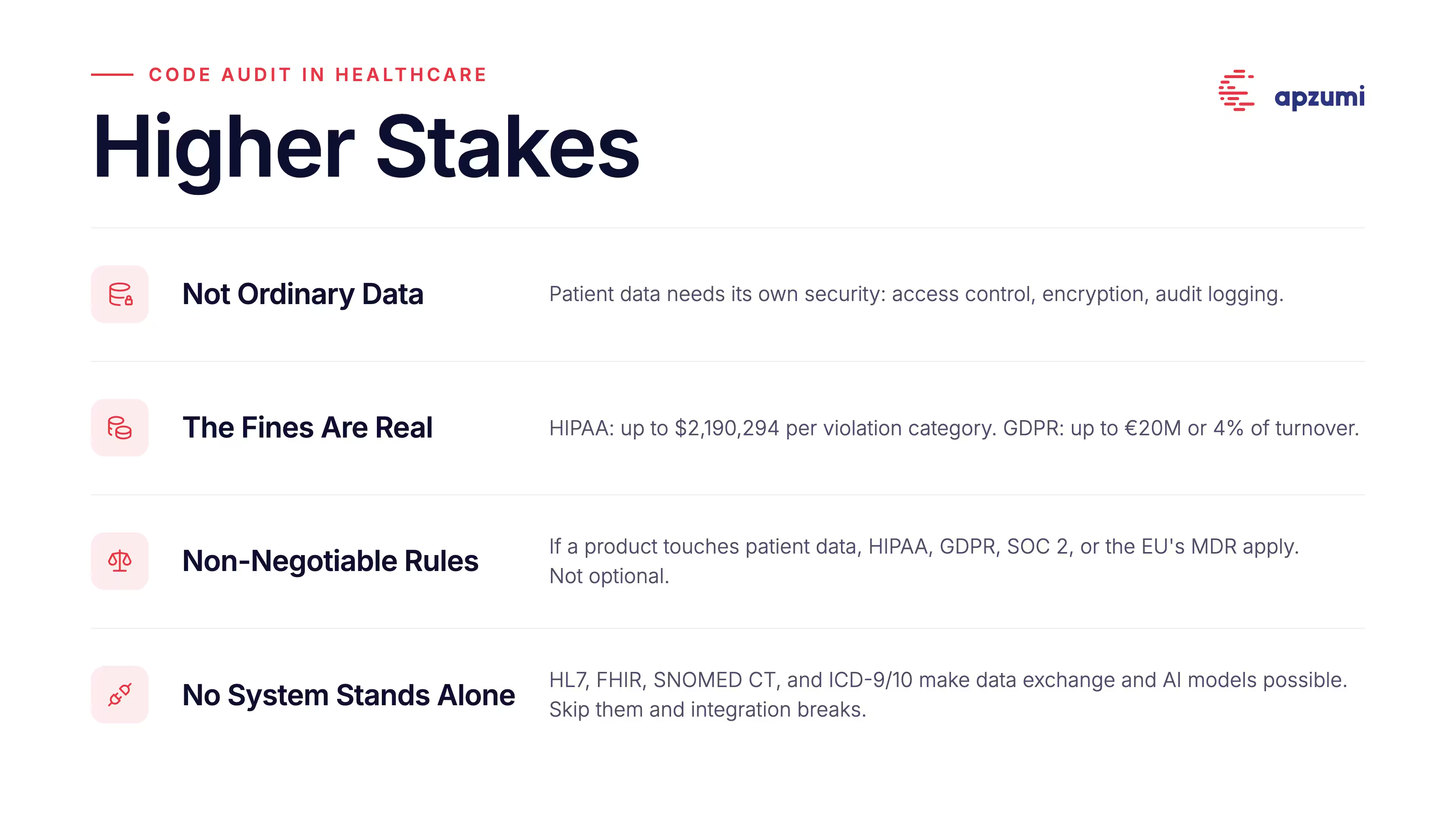
Patient data is sensitive data, and that comes with its own requirements. It isn't handled like ordinary user data. Doing it safely calls for specific security infrastructure: access control, encryption, and audit logging, not just general good coding practice.
There are real fines for handling data the wrong way. HIPAA penalties can reach $2,190,294 per violation category per year. GDPR fines can reach €20 million or 4% of global annual turnover, whichever is higher. These aren't theoretical numbers, they get issued.
There are specific regulations, and you don't get a choice about following them. If a product touches patient data, laws like HIPAA and GDPR apply, along with others depending on where it operates and what it does, things like SOC 2 or the EU's MDR. None of this is optional, it's just the cost of playing in this market.
No healthcare system operates in isolation, and that makes shared standards non-negotiable. Data has to move between systems, get exchanged with other providers, and feed things like AI models or recommendation engines, and none of that works without a common technical language. That's what standards like HL7, FHIR, SNOMED CT, and the ICD family (ICD-9, ICD-10) actually provide. Skip them, and integration, communication between systems, and anything built on top of the data gets a lot harder, or breaks outright.
None of this means every team needs a compliance department before writing a line of code. It just means the earlier someone looks at the code with these risks in mind, the cheaper the fix is.
Who This Is Actually For
By the time a team reaches out about a code audit, they tend to fall into one of three groups, and we've seen the pattern repeat often enough to recognize it early in a first call.
The first are the vibecoders. Someone built a real, working product using AI tools, often solo or with a very small team, and it does what it's supposed to do. One problem is harder to see: how much of that code they actually shaped versus how much the AI decided on its own, a gap that only grows with each new iteration, making bugs harder to trace and the software harder to build on. The other problem is more practical. They don't have a technical team of their own to take what they've built and turn it into secure, production-ready software, and that's usually the part they come to us for.
The second are post-PoC and MVP teams that have already proven the idea works and are getting ready to scale. The proof of concept did its job, but that's usually also where performance problems, security gaps, and a lack of real scalability start to show up, alongside UI/UX that was never fully polished and compliance that was never addressed at all. Fixing that is what comes next, alongside integrating with outside providers and getting ready for certifications like SOC 2 or MDR, and that's usually when they call.
The third are in-house IT teams stepping into health tech for the first time. Usually strong engineers, sometimes a whole department, but this is the team's first real project in a regulated market. Their problem is rarely skill, it's unfamiliarity: not knowing which solutions to reach for, not speaking the language a medical client speaks, not recognizing the industry's specific problems, and not knowing which approaches have already been proven elsewhere in the market. They don't need someone to write their code for them. They need someone who's seen where healthcare-specific rules tend to trip up an otherwise solid team, and who can guide the product into something compliant before it goes anywhere near a launch.
None of these teams did anything wrong by building fast. That's exactly what AI-assisted development is for. What we're usually walking into is the moment right after, when the product needs to hold up under a different kind of pressure than it was built for.
What We Actually Check
A code audit looks at four areas of a product, not a general "does it look okay" pass.
Architecture. Well-structured, maintainable systems evolve safely and stay affordable to build on. We check whether the codebase can handle new features without piling up technical debt, and flag decisions that are already becoming costly, slow, or non-compliant.
Scalability. Growth in users, data, and integrations shouldn't cost performance or stability. We look at whether the system is ready to handle that kind of growth, and how it performs under real clinical workloads rather than test conditions.
Security. Sensitive clinical data raises the stakes on every vulnerability left unaddressed. We run a code-level review focused on risks to personal and clinical data, identifying vulnerabilities, exposed secrets, and weak encryption, and give a clear view of what that exposure could actually cost.
Compliance. This is a technical check, not a certification audit. We assess how ready the code is for HIPAA, SOC 2, and GDPR expectations: access control, encryption, audit-logging practices, and whether privacy-by-design is actually built into development rather than added on afterward.
The findings don't just land in an inbox and stop there. We walk through the report together: what the risks actually mean, what realistic paths to fixing them look like, and how to sequence the work so nothing blocks the next milestone. That conversation draws on more than 13 years of experience in digital health, so the recommendations come from having seen the same gaps close before, not from reading the code once and moving on.
What a Code Audit Isn't, and Is
Worth being precise here, because it's easy to mix this up with two other things people often ask about.
A code audit is not a legal audit. It doesn't produce a certificate stating that your application is compliant with HIPAA, SOC 2, or GDPR, there's no stamp at the end of it.
It's also not a penetration test. A penetration test simulates an attack against a live system to find exploitable weaknesses in real time, a code audit doesn't attack anything, it reads the codebase itself and reports on risk, structure, and readiness.
And it's not a compliance audit either. That's a separate, credentialed process, run by a certifying body, that assesses an organization against a defined standard. A code audit doesn't replace that, it gets the technical foundation in order first, so when the real audit happens, it finds fewer surprises and costs less time and money to pass.
So what is it, then? A structured technical review of the codebase. Its scope is the code itself, what's actually there, how it's built, and where it falls short, delivered back as a report of specific risks, ranked by severity and priority. It won't produce or replace a contract, a policy, or a certification, what it does is read the code in light of what those things require, then hand back a clear, prioritized account of where it doesn't yet measure up.
What to Prepare Before a Code Audit
Short answer: not much. There's no deck to prepare and no documentation that needs to be polished first, you don't even need someone who understands the whole system end to end. What we actually need is access, the codebase, its history, whatever exists, and we take it from there.
That's really it. We do the work. That's kind of the point.
Summary
Building fast with AI tools isn't the risk, shipping that fast-built product into a regulated, high-stakes environment without a second set of expert eyes on it is. A code audit is a low-friction way to get that second look: no long engagement, no need to hand over a full roadmap, just a clear, prioritized picture of where the architecture, scalability, security, and compliance readiness of a product actually stand, before a regulator, a breach, or a client's due-diligence team finds out first.
Joanna Kasprzak
COO
Explore more



Let's stay in touch!